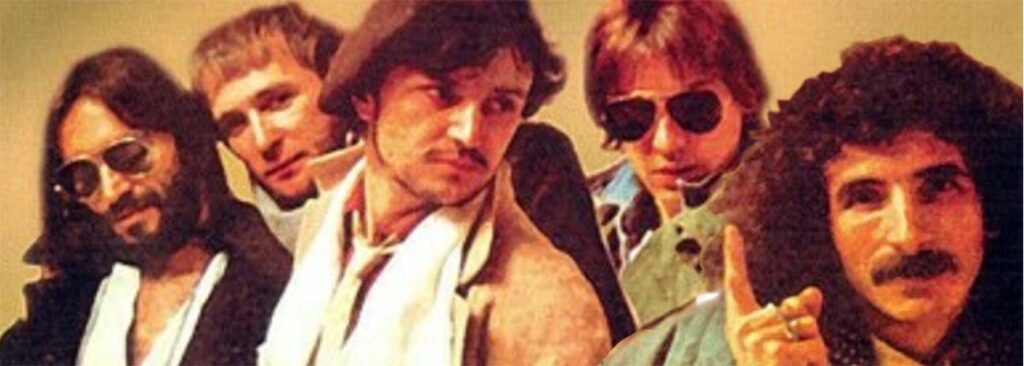
The band ‘Peter Green’s Fleetwood Mac‘ is formed in 1967 in London as a spin-off from the British blues-rock group ‘John Mayall & the Bluesbreakers’. Its most famous title is ‘Black magic woman‘ (1968), a song made famous by Carlos Santana two years later. After numerous line-up changes and 9 moderately successful LPs, Fleetwood Mac settles in California in 1975 and incorporates Lindsey Buckingham and Stevie Nicks as new members. During the next five years, the band’s wonderful compositions and original pop rock achieve massive commercial breakthrough.
Alain Souchon (born Alain Kienast in 1944), ‘Allô maman bobo’ 1977
..
Alain Souchon makes a name for himself with the songs ‘J’ai dix ans’ (I’m 10 years old, 1974) and ‘Bidon‘ (Fake, 1975) which foreshadow the singer’s gentle melodies and melancholy loser lyrics. In 45 years, Souchon releases 170 songs in 15 studio LP albums and more than 40 singles, including the wonderful ‘La ballade de Jim’ (The ballad of Jim, 1985), ‘C’est déjà ça’ (It’s already that, 1993) and ‘Foule sentimentale’ (Sentimental crowd, 1993). Alain Souchon also acts in 12 films including in the leading actor role in ‘L’Eté Meurtrier’ (‘One deadly summer’, 1983, directed by Jean Becker with Isabelle Adjani).
Alain Souchon se fait connaître avec les chansons ‘J’ai dix ans’ (1974) puis ‘Bidon’ (1975) qui préfigurent les mélodies en douceur et textes losers mélancoliques du chanteur. En 45 ans, celui-ci publie 170 chansons dans 15 albums LP studio et plus de 40 singles dont les fameux ‘La ballade de Jim’ (1985), ‘C’est déjà ça’ et ‘Foule sentimentale’ (1993). Alain Souchon joue également dans 12 films, interprétant notamment le rôle principal dans ‘L’Eté Meurtrier’ (Jean Becker, 1983) avec Isabelle Adjani.
SUI GENERIS: Charly García (Carlos Alberto García, born 1951) & Nito Mestre (Carlos Alberto Mestre, b. 1952)
..
Sui Generis is a duo created in 1971 by Charly García and Nito Mestre, who met in 1969 while studying at high school in Buenos Aires. Their debut LP album ‘Vida’ (1972) becomes the first mass-success of Argentine folk-pop and progressive rock with eight tracks that become mythical. After releasing 21 more songs in the next couple of years, Sui Generis disbands and Charly García and Nito Mestre – the two legendary ‘Carlos Alberto’ – both embark on solo careers.
Charly García y Nito Mestre se conocen en 1969 en secundaria en Buenos Aires y comienzan a tocar folk-pop y rock progresivo con amigos. Pronto forman el dúo ‘Sui Generis’ (1971-1975) cuyo album ‘Vida’ (1972) se convierte en el primer éxito masivo del rock argentino, con 8 temas que se vuelven míticos. Después de lanzar 21 canciones más, Sui Generis se disuelve y Charly García y Nito Mestre – los dos legendarios Carlos Alberto – se embarcan en exitosas carreras en solitario.
The Jackson 5 in 1969 : Jackie (born 1951), Tito (1953), Jermaine (1954), Marlon (1957) and Michael (1958)
Michael Jackson is the lead attraction of the family band Jackson Five which wins several talent contests in 1966-67, performs as opening act for various shows and releases two singles in 1968. Showcasing its sensational 11-year old singer, the band becomes popular with the launch of its single ‘I Want You Back‘ (1969) and first LP ‘Diana Ross presents the Jackson 5‘.
While leading the band to the apex of the R&B scene throughout the 70s – peaking with the hit ‘Blame It on the Boogie‘ (1978) – Michael Jackson also runs a solo-career since 1972. His LP albums ‘Off the Wall‘ (1979), ‘Thriller‘ (1982) and ‘Bad‘ (1987) make him the worldwide King of Pop music in the 80s.
..
MICHAEL JACKSON (Michael Joseph Jackson, 1958 – 2009), 109 songs in 10 LPs 1972- 2001 including:
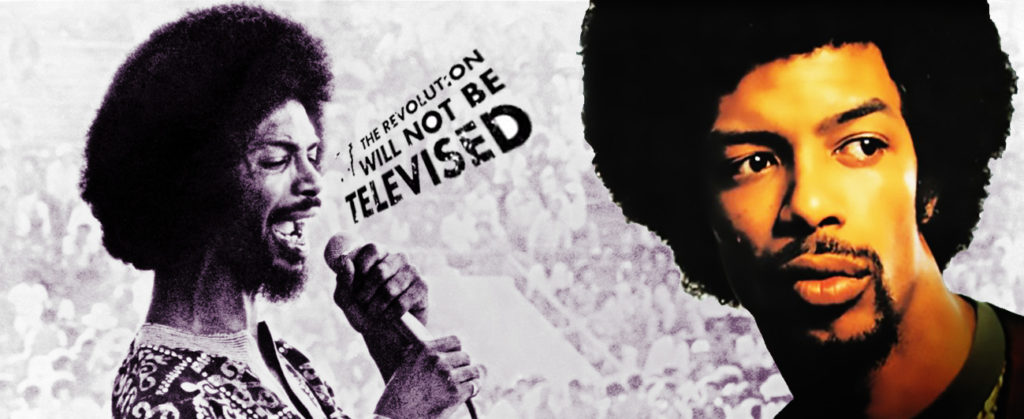
Gil Scott-Heron released 11 LPs in 1970-1982 and 2 more in 1994 and 2010. His early recordings pioneered poetic-style militant speeches and his theme ‘The Revolution will not be televised’ (1971) ranks among the earliest modern raps in history. Gil Scott-Heron has delivered proto-rap, blues, jazz and jazz-funk and achieved mass popularity with tracks like ‘The bottle’ (1974), ‘Johannesburg’ (1975) and ‘New York City’ (1976). After 1985, his life was plagued with issues related to drug-addiction, prison and hiv/aids. His 1994 and 2010 recordings were critically acclaimed as cult comebacks.
John Lennon founds The Quarrymen in 1956, a high school band playing skiffle-folk and rock’n’roll and renamed ‘The Beatles‘ in early 1960. He and Yoko Ono meet at a London art gallery in November 1966, begin a relationship in the summer of 1968 and marry in Gibraltar in March 1969. For their honeymoon, they spend two weeklong “Bed-ins for Peace” in hotels (in Amsterdam in March and Montreal in May) to protest for peace, and in particular against the war in Vietnam. In the related video-clip Give Peace A Chance, John Lennon proclaims “..there’s an alternative to violence, it’s to stay in bed and grow your hair!“. In the 10 years following the Beatles’ disbandment in 1970, John Lennon releases 23 singles and 8 LP albums, including the post-mortem 1981 single ‘Watching the wheels‘ (1981) and 1984 LP ‘Milk and honey‘. Yoko Ono co-signs three of the related LPs and sings on many of the singles’ B-sides. On December 8, 1980 John Lennon was shot dead by four bullets in front of his appartment building in New York. His killer was sentenced to prison for 20-years-to-life.
Sir Elton Hercules John (born Reginald Kenneth Dwight in 1947in Harrow, Greater London) released 30 studio LP albums and 130 singles between 1969 and 2016, reaching his peak popularity in 1972-1976.
GENESIS in 1972: Tony Banks (born 1950), Phil Collins (b.1951), Peter Gabriel (b.1950), Mike Rutherford (b.1950), Steve Hackett (b.1950) – Other members Anthony Philips 1967-70, Chris Stewart 1967-68, Ray Wilson 1996-98
..
Genesis is formed in 1967 in a Surrey boarding school by 5 pupils including Gabriel, Banks and Rutherford. Phil Collins joins the band in mid-1970 as drummer and backing vocalist while Steve Hackett joins in early 1971 as lead guitarist. The three LPs Nursery Cryme (1971), Foxtrot (1972, with the epic 23′ ‘Supper’s Ready‘) and Selling England by the pound (1973) propel Genesis to the pinnacle of the European art-rock scene.
Peter Gabriel leaves the band in 1975 and Phil Collins takes over as lead vocalist. In the early 80s, Genesis refocuses from prog rock to more conventional pop-rock and new-wave where it achieves massive commercial success. In parallel, Peter Gabriel and Phil Collins both deliver breathtaking music in their solo careers.
..
GENESIS – Active 1968-1997, 175 songs in 15 studio LPs
Horace Andy (Horace Hinds, born 1951 in Kingston) reaches the top of the charts with his songs ‘Skylarking‘ (1972) and ‘You Are My Angel‘ (1973). He reigns over reggae-dub with his distinctive voice and singing style during the next decade and settles in London UK in 1985 where his 1990-2010 collaboration with Massive Attack is a revelation.
Michel Sardou, born 1947 in Paris (photos 1972 / 1981 / 1987)
..
Michel Sardou incarne la chanson-variété française dans les années 70 et 80. Durant ces 20 ans de francophonie, même ceux qui n’aimaient pas le chanteur Michel Sardou le connaissaient par cœur, tant ses chansons sont médiatisées et ses paroles simples, uniques et inoubliable. C’est notamment le cas des quatre phrases… « Si les ricains étaient pas là, Vous seriez tous en Germanie » (1967) ; ou « On est là pour boire un coup, (..) Et pour se reboire un coup, Et pas payer nos verres » (1970) ; ou « Mais voilà, j’habite en France, (..) Où y a quand-même pas 50 millions d’abrutis » (1970) ; et « Le rire du sergent, La folle du régiment, La préférée du capitaine des Dragons » (1971) . Là où on pouvait croire à l’effet de mode, il s’avéra que le jeune Sardou avait la science du cabaret, une voix d’enfer, sa propre poésie originale et s’appuyait sur de belles musiques. La tragédie que clame son extraordinaire titre ‘Le surveillant général‘ (1972) marque à nouveau les esprits et sa chanson ‘La Maladie d’amour’ (1973) acquiert instantanément le statut de grand classique. Entre 1970 et 2000, les singles de Michel Sardou atteignent 50 fois les hauts du hit-parade français.
..
Michel Sardou embodies the popular French-song in the 70s and 80s. During these 20 years of ‘Musique-variété’, even those who do not like the singer Michel Sardou know his opus by heart, as his songs are massively broadcast and as his lyrics are immediately unforgettable, e.g. as in the four sentences … “If the Ricans hadn’t been there, you would all be in Germania“; or “We’re here for a drink, (..) And for another drink, And for not paying those drinks“; or “But here it is, I live in France, (..) Where there’s still not 50 million morons”; or “The Sergeant’s Laughter, The Madwoman of the Regiment, The favourite of the Captain of the Dragoons”. What might’ve been a fashion fad turned into a demonstration by the young Sardou, with cabaret mastery, original poetry, beautiful tunes and a hellish voice. The tragedy proclaimed by his extraordinary track “Le surveillant général” (1972, The general supervisor) once again struck people’s minds, while his song ‘La Maladie d’amour’ (1973) acquired the status of great classic upon its release. Between 1970 and 2000, Michel Sardou’s singles reached 50 times the heights of the French charts.